
Day 7 – Wednesday 14th October

Sighișoara to Brașov via Viscri and Prejmer
It’s sort of hard to know where and how to continue this blog/story. The enigmatic gift that is Romania keeps on giving. Going back more than 12 months when we planned this trip, it really was no more than a whim which brought us here. The trip was simply to go to Istanbul and looking at a map I chanced on Romania simply because it was nearby. What a mistake it was to discount it so flippantly, and what a bonus it has been to visit here. Enigmatic? Well, the combination of a modern motor industry, high-tech businesses (Bitdefender was founded and is headquartered in Romania), oligarchs, gypsies, goatherds and shepherds, modern towns and old castles make Romania hard to label simply.
We started the day in Sighișoara. Oh, it’s 1,000 years old or so, a walled town with a wonderful centre which is easily wandered around. The Fronius Residence (guest house) we stayed at is a mere 400 years old; our (huge) room displaying the wonderful arched ceilings of that time. And as I have now come to accept as normal, the service at the Fronius was almost beyond perfect. After a leisurely breakfast (and Janet had some urgent work to attend to) we set off with Victor for a walk around town, which included a walk to the top of the 13th C clock tower and associated museum.

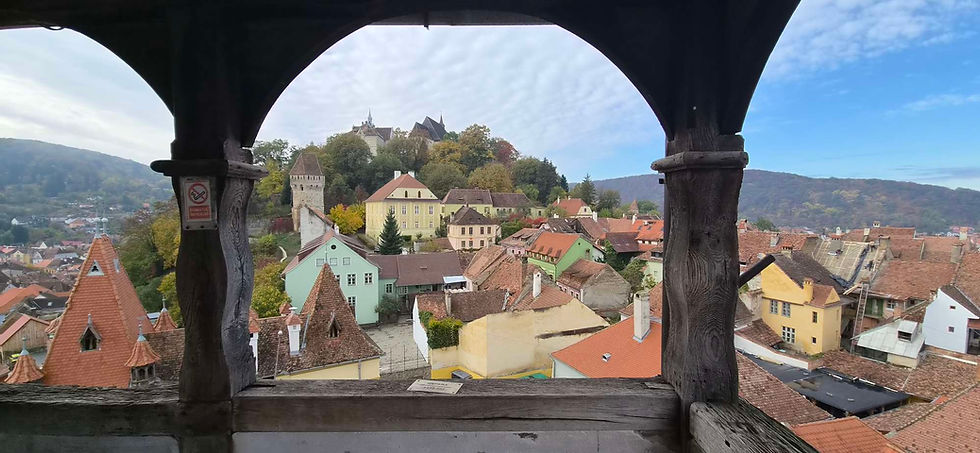

Apart from all the general mediaeval architecture and layout, of note in the town is the building that Vlad Dracul (Vlad II) lived in from 1431-1435/6, and in which his son Vlad Dracula (Vlad III, the Impaler) was born. A brief history lesson. Vlad II was a member of the Order of the Dragon, a chivralic order founded in 1408 primarily to fight the Turks (the then Ottoman empire, comprising tribes not just from Türkiye as we know it today, but others from the north and east of present day Türkiye). Vlad took the name Vlad the Dragon, from the Order; dragon being spelt Dracul in the then language. When Vlad’s son Vlad (III) was born, he became known as Vlad the son of the Dragon, or simply Vlad Dracula. The connection to Count Dracula, from Bram Stoker’s novel of 1897, is tenuous at best. Yes, Count Dracula came from Transylvania, but the nexus between the Count and Vlad Dracula is unclear, depending on who one researches.


There is little doubt that Vlad Dracula was a real life person, and a cruel one at that, and I will write more about him tomorrow. But all the same, here we were, at the place of his birth.
The next stop after Sighișoara was the village of Viscri, and a couple of related but completely different experiences.
Viscri is an old Saxon town, although many of the old Saxon residents left and returned to Germany in the 20th century. Rather than re-tell that story I’ll simply point you to a version here. Many fine examples of the Saxon houses remain. Not today, but maybe later, time permitting, I’ll return to the subject of forced deportations to the gulags which was a fate suffered by the Saxons, and others, under both the Russians and Ceaușescu.


But first we visited the gypsy part of the town. By now it should be fairly obvious that Victor holds the gypsies in particularly low regard. How much is just him versus the wider population is unclear, but my guess is that his views are fairly widespread. But a day or two back he spoke highly of the particular place we were to visit. As we approached, he told us to “wait here” (I obeyed this time!) while he checked that it was OK to visit. He was greeted with a hug from one of the men, and then a wave, from the gypsy man, to come in. Very different to two days earlier.


Enter into the story Gabor Istvan and his brother Gabor Matei. Istvan (Steven) was the first one we met, the one of the hug and the wave. Matei (Matthew) appeared a bit later. Their story, in summary, goes like this. Matei (the eldest) and Istvan’s grandfather was a blacksmith. He wanted his grandsons to have a better life than that of the general gypsy population, and taught them blacksmithing skills. Their father was apparently a drunk, in and out of gaol, and doesn’t enter into the story. The farming community locals used to bring their machinery to them to get repaired (and still do) and to get horseshoes made. One day, in the late 1980s, the then Prince Charles visited the brothers, and they advised that the horseshoe business was declining, and so they were struggling financially. Out of that conversation came the idea that they should make mini horseshoes for tourists as souvenirs. And voila, a new business sprung up. Last year they had 10,000 visitors to their foundry; not just ones and twos like us but 40s and 50s from the Viking cruises. Matei is the key operators, and is trying to build a sustainable business future for his son, aged 14. Istvan, I gather, has an alcohol problem like his father. Some photos/videos follow. (Interesting was that Matei’s wife dresses in the long flowing red skirt fashion which we had noticed a couple of days earlier, but the men dress differently to those of previously. Apparently they belong to a different caste from the earlier folk.)


Which brings us to part 2 of the Viscri story. After lunch (very nice, at Viscri 32 – see the pattern there?), we visited The King’s House, Viscri. I’m intrigued by but not a huge fan of the royal family, but putting that aside I can see how Charles and his foundation have done wonders for rural Romania.


Speaking of rural Romania, I have been intrigued to see the dichotomy of very large broadacre holdings (wheat, corn) and shepherds seemingly wandering the countryside with their flocks and dogs.
Anyway, last stop for the day was a fortified church at Prejmer. First built in the 1200s, it was designed to hold up to 200 families from then then surrounding village to stay as a refuge in times of siege. It is one of some 120 remaining in Romania, many (all?) UNESCO listed.


Then on to our final stop for the day, the city of Brașov. Check in to our hotel/guest house (very nice), a quick trip up the cable car to the top of the adjoining mountain, a couple of photos in the cold, and back for dinner and work/sleep.


Comments