Hoşça kal Konstantinopolis

Updated: 12 hours ago
Days 13 – 16 – Tuesday 20th to Friday 23rd October
As I said (or at least alluded to) in Tuesday's post, it just didn’t feel right to be doing the whole tourist thing and then telling the world all about it as if nothing was wrong given the events of last Monday. Not that there’s the slightest thing I can truly do about that crazy world.
So I just sat with that feeling for a few days and decided that to wrap things up with a farewell post now felt about right. So here I am once again. As I’ve said on a few occasions over the years, I write these blogs because I enjoy writing, and they serve as a permanent record, along with my millions of photos, of the times away. [“Millions” is an ever so slight exaggeration – I’ve taken some 1200 photos on my phone over the last 7 days, and perhaps a quarter of that number on my camera. Digital photography makes us lazy btw. In the old film days (some of you might remember them) a roll of 36 photos a day was almost an extravagance – and the exposure/shutter speed/f-stop of every shot was thought about. But I digress.] I also know that there’s a small cohort of folk out there somewhere in e-land who seem to enjoy my ramblings and my photos. I don’t really know who you all are – there’s somewhere between about 20 and 40 of you – but if these posts and their photos bring a little bit of joy in one form or another I’ll take that as a good thing.
So here we go. I’ve been fascinated by Istanbul. Thousands of cats (literally – unofficial estimates are between 125,000 and 300,000 free roaming cats, and potentially up to 1,000,000.) The cats have legal protection, although it’s not always been that way. Shops, local councils and individuals put out food for them and generally care for them. Their history goes back centuries, but it would seem that it was the Ottomans that first officially welcomed them. 15 dogs – again, almost literally, that’s about the number I counted over the 7 days. Hundreds, maybe even thousands, of vendors hawking for business: carpet sellers, restaurant staff, dodgy perfume or cigarette sellers, shop owners in the bazaars, you name it. The best line I recall was “good evening sir, how can I take some of your money?” Abounding politeness. Not once, in the hundreds of times that I said “no thanks” (in a variety of ways) did I get any displeasure or even anything even remotely approaching it. Often, quite the opposite. A bit of a chat and then everyone moved on. The 5-times daily call to prayer. By some estimates this is a city which is 90% Muslim, and Mr AI Google tells me that there are 3,600 mosques in greater Istanbul. So as you can imagine, the call to prayer rings out widely. It’s a sound I like. Despite the noise, there’s a certain peace to its meaning. Closely related to that, the antiquity; the churches (now mosques) built in the 5th century, or the roman cisterns in the 6th. The crazy energy of the place. The at times gridlocked traffic; the police sirens; the motorbikes (the police bike, with a pillion passenger, whizzing up the footpath scattering pedestrians - i.e. us, and others - because the road was busy, was one of the more memorable motorbike experiences); the sometimes endless crowds. The food. Chicken kebaps anyone? Gözleme. Çay (Turkish tea), served in little glass cups on red (usually) spotted saucers. Baklava and multiple derivatives, everywhere. Pistachio sand coffee – awesome. Whirling Dervishes. And that's just a “scratch the surface” picture.

And now just a little bit of detail of the last four days.
Tuesday (20th)
Tuesday, the day of the non-blog, had three main components.
Firstly, a tour of the Basilica Cistern. It has an almost discrete entrance right alongside one of Istanbul's tram tracks, with thousands of pedestrian feet padding by every day. The entrance sign aside you wouldn't know there was a huge underground reservoir nearby. Built by the Romans around the 4th century as one of 200+ underground water storage facilities in the city, this place is truly magnificent. Originally holding 80,000 m3 of water, its roof sits on 336 recycled stone pillars. The engineering feat is truly mind boggling. “Recycled” in this sense means that they took the pillars from all over the Empire and brought them here, so the pillars are an absolute mismatch. The floor space covers some 10,000 m2, and we were told that the whole thing was built in under 5 years, which begs the question how does an ancient civilisation excavate a hectare of underground cavern and bring in 336 10-metre high pillars from around the place to support the very ornate roof of the structure, and do all that in less than 5 years?
I do know the answer by the way …


Continuing the Roman theme, next was a wander though town to the Aqueduct of Valens, a 4th century structure named after the Emperor Valens. Apparently the original aqueduct (not all of it high above ground I guess) was some hundreds of kilometres long. That this almost one-kilometre-long structure has survived the ages is itself remarkable. Almost equally remarkable is the fact that the incredibly busy Attaturk Boulevard passes through 4 (I think) arches of the old structure.


Wandering back into the main part of town we came upon another cistern – the Zekrek Cistern – at 50m x 18m with walls up to 5.2m thick to counter the pressure of the water it used to hold, it’s not as large or quite as fancy as the Basilica Cistern, but all the same an incredible engineering feat.

Our last activity for the day was a ferry ride across the Bosphorus to Üsküdar. Just for fun. And back. Just to say we left Europe for a while and went to Asia.


Wednesday (21st)
After a pistachio sand coffee with our local barista Muhammad, and interspersed with just wandering around town, today had two entirely different activities – a guided tour and then extended visit of the Topkapi Palace followed by an early evening exhibition of Whirling Dervishes. Both were amazing.

The opulence of the Palace has to be seen to be believed. The 86 carat Spoonmaker’s Diamond, the fourth largest in the world, is just one element; no-one seems to be able to state its value. I don’t recall that we saw the diamond’s poor relation – the emerald dagger created in the 1750s for the then Shah of Iran and reputed to be worth a mere USD50m. But the treasures in the Imperial Treasury are mind-boggling. I read somewhere that the “priceless” collection – literally – whilst not able to be valued, is regarded as the second most valuable in the world. And apart from the two soldiers at the Imperial Gate with assault rifles of sorts, very little obvious security.
And that was just the Treasury. The rest of the Palace contains opulence rarely seen. And the view over the Golden Horn and the Bosphorous from various balconies is stunning.


The Dervishes were fascinating in an entirely different way. I had heard of them, but really had no idea of their history or their spiritual/religious underpinnings. This for me was one of the highlights of our week in Istanbul (big call that).

Thursday (22nd)
First order of business was a visit to the Kariye Mosque. Also known as the Chora Church, it was first built in the early 4th century. Renovated in the last few years, the mosaics, albeit patchy in places, are absolutely stunning. That such art could be made some 1700 years ago and still survive blows me away.


On our way back down (literally, it's on a hill) we passed through the somewhat funky Balat district, purely by accident.


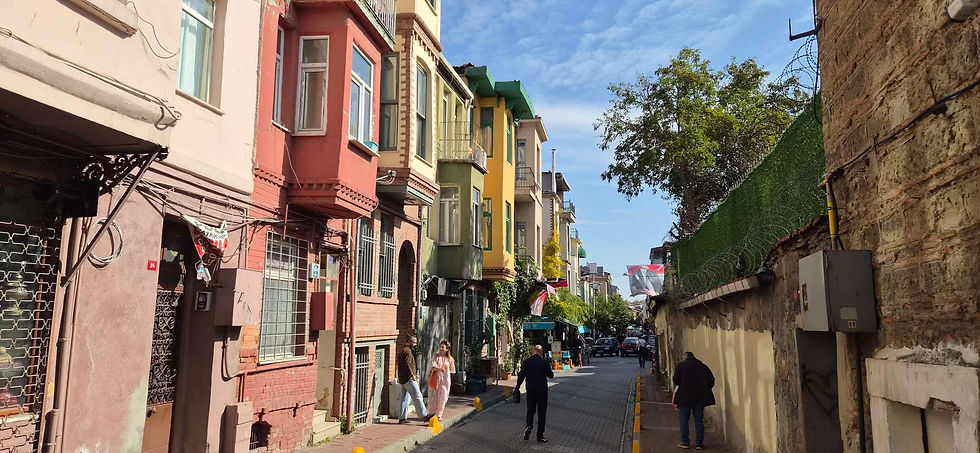
We then decided to head back into Asia – another ferry ride across the Bosphorus, this time to the district of Kadikoy. Again, just for fun. This area is reputed to be less busy, less touristy, lower priced than downtown Istanbul, but that was not our experience. It was fun though, and after wandering around we found a good corner coffee shop for watching the world go by.


Friday
Today was our last day. I had sort of mucked up our accommodation. Checkout was midday, and car to the airport wasn’t booked until 9:30pm (for a 1:40am flight - uurrgghh), which meant we had to store bags and with no easy way to change pre-flight. So I booked an extra room (at another hotel down the road) to provide us with a base for the day. Good call.
After yesterday’s Kariye Mosque visit we’d wandered (quite accidentally) back through the very funky Balat district, and decided on our last days to go back there. I had an ulterior motive – yesterday I’d forgotten to go a little further to see the old Walls of Constantinople, so today we combined the two. It’s about a 4.5 klm walk from the hotel(s) and so rather than do a there and back trip like yesterday we decided to catch the very modern No 5 Tram up to Balat, walk to the walls and then stroll home to both our hotels.
The walls are amazing; we probably only saw a small section. They go back to the 4th and 5th centuries, and over the millennia have withheld assorted attacks and sieges, before falling in 1453 to the Ottoman Turks, which date saw Constantinople renamed Istanbul and the end of the western Roman empire.


And a Balat revisit, and a few assorted scenes ...


So that pretty much wraps up the Istanbul part of the trip. Fascinating town (well, huge city). Not sure that I am particularly pressed to return, but what I will do when I get settled is to re-read Richard Fidler’s 2006 book Ghost Empire, a chronicle, of sorts, of old Constantinople. I had read it a long time ago, and it will be interesting to see through fresh eyes and personalise some of the places and times he speaks about.

A final comment I feel compelled to make. In both large cities we visited – indeed all towns – I never had any safety concerns. Wandering through central Istanbul as night felt as safe as anywhere I’ve been, indeed safer than some. It’s got a real buzz to it, even in those parts which are obviously slightly off the “normal” tourist path. Not that there is a normal path really – even wandering down the most obscure back streets there’s people everywhere who are obviously visitors. On two nights we went to eat at a place which Google had identified as being where the locals go to eat, and guess what, on both nights all the patrons were or looked like visitors. Perhaps that’s why it felt so comfortable just wandering.
= ~ = ~ = ~ = ~ = ~ = ~ = ~ = ~ = ~ = ~ = ~ = ~ = ~ = ~ = ~ = ~ = ~ = ~
The above marks the end of this blog set, at least for now. I might make a "reflections" post in a few weeks, but for now when I was asked for highlights of this last couple of weeks (and yes, we were away for only 16 days, although it felt a lot longer than that), my initial response was:
the whole Romania experience. I felt that I had stepped back into recent real-time history, made possible by the helpfulness and expertise of our guide Victor Zamfir
the history of Istanbul, nee Constantinople. An entirely different step back in time experience, time in this case going back almost 2 millennia
specifically, the Whirling Dervish experience, due to its absolute spiritual uniqueness.


Another lovely post. I've read the book too and it is wonderful. Very good to hear of a world we often demonize as it is different than ours. Well do done Peter and Janet.