Here Comes The Sun

Huitième jour - Wedesday 24th June, Lectoure - La Romieu - 17.5 klms (running total approx 149.2)
I had thought that I had used this title once before, years ago. I had, almost, but not quite (see Sunflower). I grew up on the music of the Beatles, and this one from George is one of my favourites. Hard to pick favourites of course. But I think for today the variation Here Comes the Cool would be even more welcome.
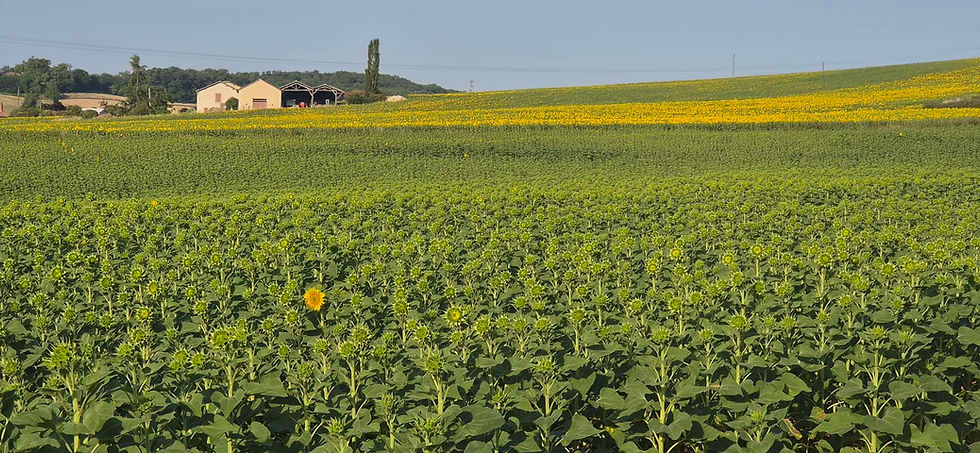
We continue to walk through agricultural land, and the emergent sunflowers are a real fave. Can one horticulturally anthropomorphise? If so, they look so happy. I love the brightness they bring to our surroundings. Most crops haven’t bloomed just yet; this field was spectacular.


Generally speaking, there are two types of surfaces we walk on – dirt pathways across fields or through forests, or local sealed roads. Each has there advantages and disadvantages. The dirt paths tend to be cooler under foot, often with various sorts of grass coverings. They also tend to be more uneven, worn down over the years by tens of thousands of feet and the occasional hoof, which slows the pace and requires us to be careful as to where to place one's foot. The ground appears to be mostly clay-based and the paths are criss-crossed with striations of cracked dirt, some of the furrows being a couple of cms wide and quite a few deep. Judging by the shoe (and hoof) imprints, not all that long ago many of the paths were rather muddy. The roads tend to be less forgiving underfoot especially due to the heat, but easier to walk on. Both can be shaded or sunny. We walk at between 4 and 5 kph on the roads, and around 3 on the paths, depending on uphill, flat or downhill also.


I almost had a disaster today. Well, perhaps disaster is a bit strong. Completely unbeknown to me, my camino shell, which was given to me by my daughter around 2015 just before we first walked the Camino Frances, and which to date has travelled almost 3,000 kilometres with me on my scrubbly old Aarn backpack, decided to go its separate way. We were resting in the shade about 6klms from today’s destination when three pelerins walked up, one carrying the runaway shell saying “I found this; is it yours?”. Amazement all round. Shell reunited with Aarn. Me happy. What are the chances???


I am drafting this from La Romieu, our penultimate destination for the day. Cat town. The local legend goes like this:
In the year of our Lord 1338, in a Gascon village called La Romieu, renowned for its beautiful collegiate built twenty years previously, Vincent and Mariette lived contentedly. He was a woodman and his wife often accompanied him into the forest to make up bundles of faggots.
They worked hard, and with their poultry and pig, their fruit and vegetable garden, their table was always laid full with food. They had been married for three years when Mariette gave birth to a litle girl, whom they called Angeline.
Alas, one day Vincent was crushed by a tree he was felling. Inconsolable, Mariette sank into a depression and two months later was found dead, holding little Angéline in her arms.
The little girl was taken in by a neighbour and was brought up with their children like one of their own. Angéline showed a great affection for cats and there was always one or two around her which at night even slept in her bed.
She also often shared her bowl with them. With the passing of time, Angéline became a healthy young gir who helped her adoptive parents in fields, always accompanied by her cats.
In 1342 and two years that followed, the winters were harsh and the spring and summer so wet that it was impossible to sow their crops.
They thought of the numerous cats in the village and set about catching them.
Angéline’s parents, knowing how much she loved hers, allowed her to keep a male and female cat on the condition she hid them well, as the neighbours would gladly kill them. Angéline, therefore, shut her two cats in the attic by day and at night she let them out to hunt. But the famine grew worse and many villagers died.
Angéline and her parents barely subsisted by collecting roots in the woods and sometimes they found mushrooms but it was hardly sufficient.
Weakened by hunger, they managed somehow to survive this terrible period and more clement times finally arrived, allowing them to harvest what they needed to live.
But in La Romieu where the cats had disappeared, the rats proliferated to a point where the crops were once again threatened.
Angéline, with infinite caution, had been able to hide her cats in the attic and they had produced several progeny.
There were now about twenty of these cats. The villagers wrung their hands over the damage caused by the rats. Angéline announced that she was going to release some twenty cats which the inhabitants would be able to adopt.
The rats rapidly disappeared and it is thus that Angéline resembled more and more, with the passing of time, that of one of the cats and that her ears transformed into the ears of a cat.
Copied from a local tourist brochure. A variation which I also read, which is implied above, is that the villagers caught the cats to eat them. Angéline permitted her cats to be released on the condition that they never did so again.


The legend refers to the collegiate.
Its full name is the Collegiate Church of Saint-Pierre. As best as I can ascertain a collegiate is a sort of teaching monastery, not quite a monastery and not quite a cathedral. In this case this collegiate first started as a priory originally founded in La Romieu by two monks who, according to tradition, were returning from a pilgrimage to Rome—hence the name. In 1312 Cardinal Arnaud d'Aux acquired the site to establish the collegiate church, and the rest is history. The complex suffered badly during the Wars of Religion (1562-1598) and the Revolution (1788/89), with much of the complex destroyed. Today it is a UNESCO monument and is in the process of being restored.
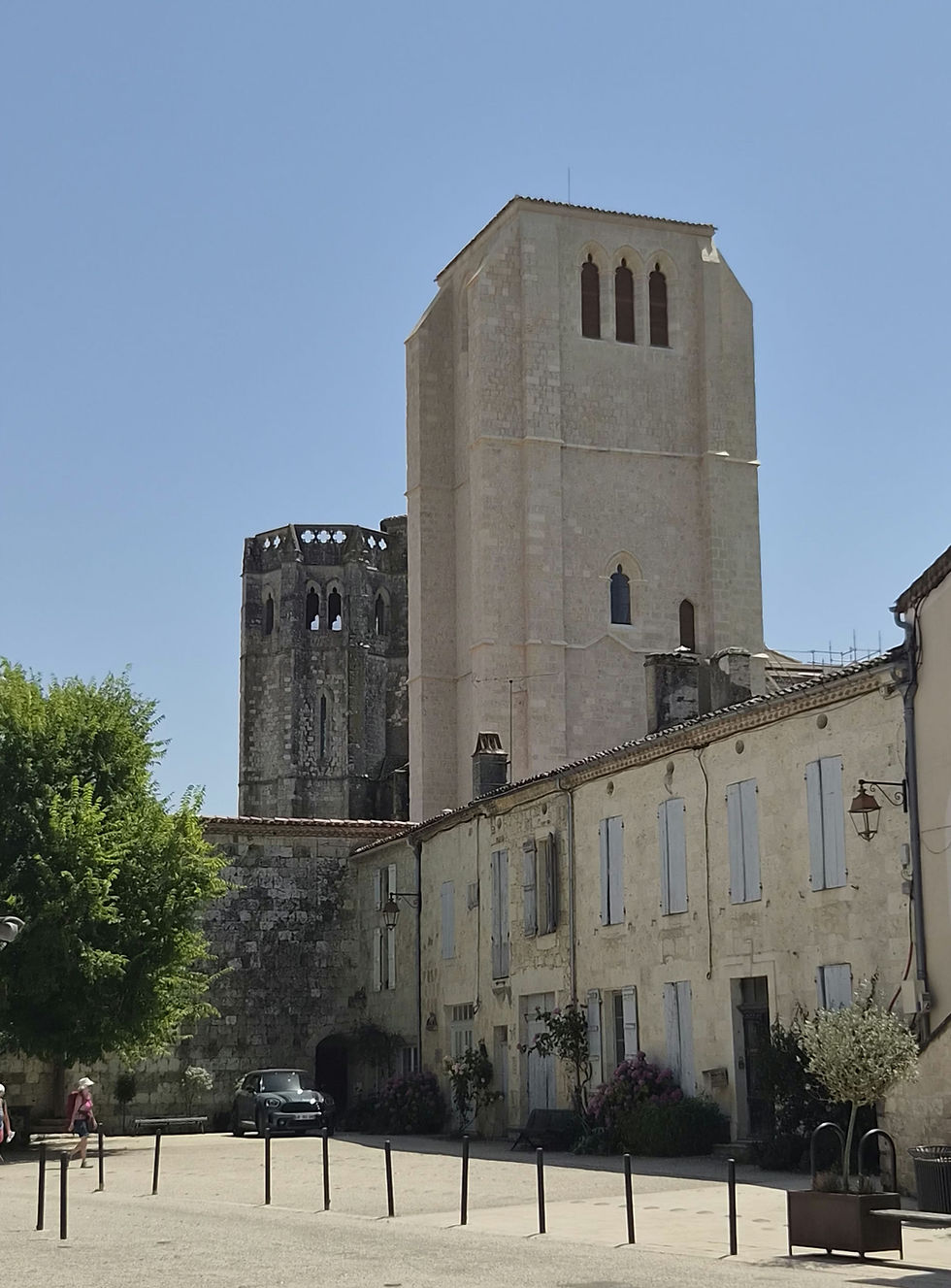


We've noticed, btw, that the blue sky of France lacks the vibrant and piercing colour of its neighbour not far from here. Wonder why??
We are staying at a guest house about 4klms out of town, a detail I had forgotten until today. As a last straw we could have walked the final klms, but our host for the night, Alain, kindly agreed to drive into the village and collect us. As we drove back out he pointed to the car thermometer, showing 41-degrees. Good call.
They have a swimming pool, with water temperature of 31-degrees. A perfectly acceptable choice.

And to close, a post swim/shower selfie. Clean people, with old dog ...

Tomorrow Alain will drop us back into town from whence we have a perfectly tolerable 13.5 klms to stroll into Condom. 38-degree max tomorrow. Luxury 😉.


Great to tread your thoughts and happy you were reunited with your shell, you must have some good karma. Looking forward to seeing a cloud in your photos soon!
Oops....I forgot to mention your shell and it's return to your pack...I hope that it is tied on tightly this time and that it gets to see many more ks walked.
Stay as cool as you can, think cooling thoughts as you walk.
I love the history lesson. Hoping that today's walk will be a good one and that shade will be your companion. Blessings.
Nice shell, cat and footpath notes. You both look well. Take care not to underestimate the heat. Sada and Margaret.